
The Lezoux site has a long history. How does it fit into a local community-focused approach today ?
Clément DUVAL: The site has been located in Lezoux for nearly two centuries. It initially processed walnuts, before turning to various oil-rich seeds. Today, we process sunflower seeds, and this evolution illustrates the industry’s ability to adapt to the needs of agricultural sectors. We continue to work with French agricultural production, and we make the most of every part of the seed :
- The hulls of the sunflower seeds, known as “husks,” are used as fuel for our biomass boiler and provide the energy required for production,
- the solid, protein-rich part is used as feed for livestock,
- and the crude oil is refined at another Avril site for food use.
And this local commitment also extends to the attention we pay to the women and men who keep the site running, both employees and partners: safety is a daily requirement, deeply embedded in the way we work… and we also make sure that working conditions enable everyone to build a long-term career and carry out their job in good conditions. Today, the site has 43 employees and supports twice as many indirect jobs in the local area.
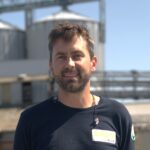
Clément DUVAL
Director of the Saipol plant in Lezoux (63)
The site has therefore evolved, and investments have been made. What guides them today ?
C.D.: Our investments are aimed at ensuring the reliability of our facilities, regulatory compliance, and sustainable industrial performance. They are made with a long-term perspective, with the aim of maintaining a lasting presence within our local environment. This has always guided our investment decisions, as demonstrated by the installation of a biomass boiler more than ten years ago. This equipment was a pioneering step towards today’s decarbonization efforts and reducing our dependence on fossil-based gas. More recently, we have invested in the overall modernization of our facilities: this includes the production workshops, as well as the drivers’ reception area and temporary administrative offices, pending a future phase of construction work.
The site has expanded by incorporating adjoining buildings, and we have also invested in facilities that drastically reduce our water consumption.
Over the past five years, in line with the reinvestment model supported by the Avril Group, approximately €25 million has been invested to improve the reliability and modernize the facilities.
So, investments that are visible to local residents living near the industrial site ?
C.D.: Yes, and throughout these investment projects, we have made a particular effort to keep our local residents informed: first, to explain our activity and the nature of the work being carried out, but also because our teams are proud of their professions and of the projects they are leading to add value to French agricultural production through our industrial facilities. Our activity is fully integrated into local life, and this local presence also means remaining attentive and listening to the community.
In practical terms, how does it work?
C.D.: We are continuing along the same path. A public information mural created by my predecessor was displayed on the exterior walls of the plant in 2023. It illustrated our commitment to openness and marked the beginning of visits for local residents. We are continuing these regular visits, as well as the Open Days organized by the local community of municipalities and initiatives such as Professeurs en entreprise, specifically aimed at teachers to help guide young people in their career choices.
These are valuable opportunities to engage directly and transparently, share our plans for the plant, and discuss its place within the town and the wider local area.
We are also seeking to strengthen communication with local residents through various channels: the town hall’s PanneauPocket app, the Saipol webpage dedicated to the Lezoux site, and more. These regular, direct exchanges are invaluable in maintaining a constructive dialogue.

An exhibition on the walls of the plant told the story of its history, its professions and its evolution. A way of asserting that French industry can be both rooted in its local community, modern, sustainable, and fully committed to food sovereignty.
Despite these efforts, industry still suffers from certain misconceptions. What would you like young people – and more broadly, local residents – to understand when they come to discover the Lezoux site ?
C.D.: I would like them to have no doubt that today’s industry, and our plant in particular, is very much alive, aware of sustainability challenges, and focused on the future. While our history goes back a long way, the site is brought to life by our teams and their diverse, very much current areas of expertise: safety, maintenance, quality, environment, logistics, and many other professions. We are also particularly proud to work within a French company, a subsidiary of Avril, which continues to invest in its industrial facilities to contribute to food sovereignty, while taking today’s societal expectations into account.
Reduce water consumption
Between 2022 and 2024, the Lezoux site reduced its water consumption by 40% by strengthening the analysis of consumption data and investing in less water-intensive facilities.
This project is an important step towards achieving Saipol’s objective of reducing water consumption by 20% by 2030, in line with the “Acting to protect natural resources” commitment set out in its purpose, Servir La Terre.
➡ 📺 Gaelle MUNSCH, QHSE Manager at the Saipol Lezoux site, explains the actions implemented in this video (excerpt from Saipol’s internal news program):
To find out more about the latest news from the site and how to arrange visits for local residents, visit the Lezoux site presentation page on saipol.com.

