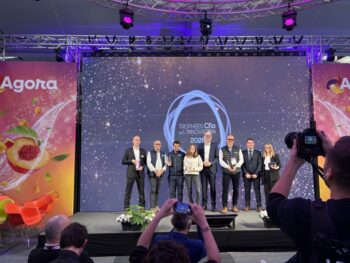
A first in the road transport market
As shippers step up their emissions reduction requirements and the road transport sector needs to accelerate its energy transition, DUPESSEY&CO is taking a pioneering approach.
A partner of Oleo100 since 2021, the group is now becoming the first transport company to adopt Oleo100 Bas GES, an offering based on the Empreinte by Saipol programme, which recognizes and ensures the traceability of regenerative and low-carbon farming practices, particularly within the French rapeseed sector.
This development enables the transport company to strengthen its decarbonization pathway while maintaining the same operating conditions.
No changes are required to the trucks, tanks or logistics organization.
“For several years, we have chosen to take action with concrete, immediately operational solutions. By becoming the first user of Oleo100 Bas GES, we are continuing along this path: further reducing our emissions while ensuring that our customers receive the same quality of service and the same operational reliability.”, Audreyne COPET, Communications & CSR Director at DUPESSEY&CO
Over 750,000 liters consumed and 1,500 tonnes of CO₂ avoided
The decision to deploy Oleo100 Bas GES is based on already significant results.
In 2025, DUPESSEY&CO consumed more than 750,000 litres of Oleo100, avoiding more than 1,500 tonnes of CO₂ emissions compared with conventional diesel fuel.
The biofuel is now distributed at three strategic sites operated by the group:
- Rumilly (Haute-Savoie)
- Lyon area
- Vedène (Vaucluse)
By the end of 2026, 44 trucks will be running on B100, representing nearly 25% of the fleet.
An immediate response to decarbonization challenges
Unlike other solutions requiring major investments or vehicle replacement, Oleo100 Bas GES can be integrated directly into existing infrastructure.
For transport companies, this compatibility provides a fast way to reduce emissions.
“The energy transition in transport cannot rely on a single solution. Oleo100 Bas GES provides an immediately deployable solution for companies looking to accelerate their decarbonization while supporting farming practices committed to the environmental transition.”, Thomas VIAL, Eastern Sales Manager at Oleo100